
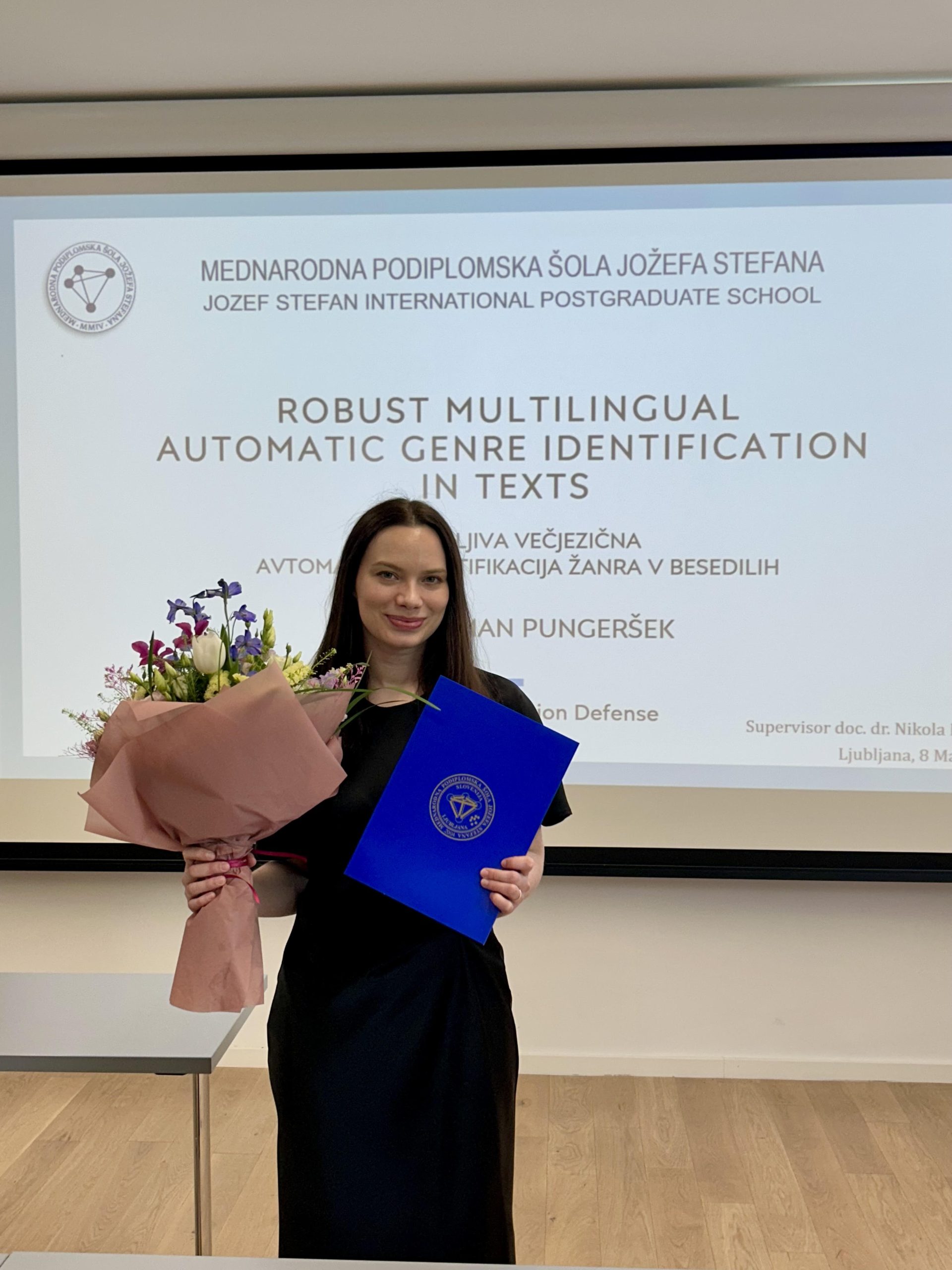
Taja Kuzman Pungeršek successfully defended her doctorate thesis titled Robust Multilingual Automatic Genre Identification in Texts.
Congratulations!
Abstract:
Collecting texts from the web has significantly accelerated the creation of large text datasets
which are essential for the development of advanced language technologies, including large
language models. However, because these texts are gathered automatically, their linguistic
and functional characteristics are largely unknown, limiting their reliable use in research
and applications. Automatic genre identification, a text classification task that categorizes
texts into specific genre categories, provides key insights into such large-scale text
collections and enables their filtering for applications in language technology and linguistic
research.
This thesis advances automatic genre identification for web-scale multilingual text data
through the creation of novel genre schemata, the development of manually-annotated
genre datasets, and the exploration of robust machine learning methods. First, the
study introduces new genre schemata designed to improve annotation reliability and
cross-schema comparability, thereby addressing a key limitation of prior work where
incompatible schemata hindered meaningful comparison across studies. We demonstrate
that high-quality manual annotation with acceptable inter-annotator agreement can
be achieved through a carefully designed genre schema, detailed guidelines, and the
employment of expert annotators.
To address the lack of high-coverage genre datasets in our target languages, we develop
high-quality, manually-annotated genre datasets in Slovenian and English, as well as
multilingual test collections spanning eleven typologically diverse languages and different
scripts. Building on the test datasets, we establish the AGILE benchmark, which enables
standardized, reproducible cross-dataset and cross-lingual evaluation of genre classifiers.
The benchmark also supports a systematic comparison of modern large language models
across languages.
Using this infrastructure, we develop genre classifiers that achieve robust performance
across various languages, datasets, and evaluation settings. To ascertain which machine
learning methodology offers the most robust generalization, we experiment with a range
of text classification techniques, ranging from traditional non-neural machine learning
methodologies to cutting-edge approaches based on large language models. Our findings
indicate that a BERT-like model, fine-tuned on our newly developed training dataset,
achieves state-of-the-art performance across various datasets and languages, including languages
using non-Latin scripts and languages not closely related to the fine-tuning languages.
The resulting model is publicly released, providing a practical tool for large-scale
automatic genre annotation of multilingual web text collections.
Furthermore, we propose the LLM Teacher-Student Framework, a novel approach for
training text classifiers without manually-annotated data. By leveraging a large language
model to generate training labels, this method enables scalable, cost-efficient development
of genre classifiers, particularly for low-resource languages and specialized domains, and is
applicable beyond genre identification to other text classification tasks.