
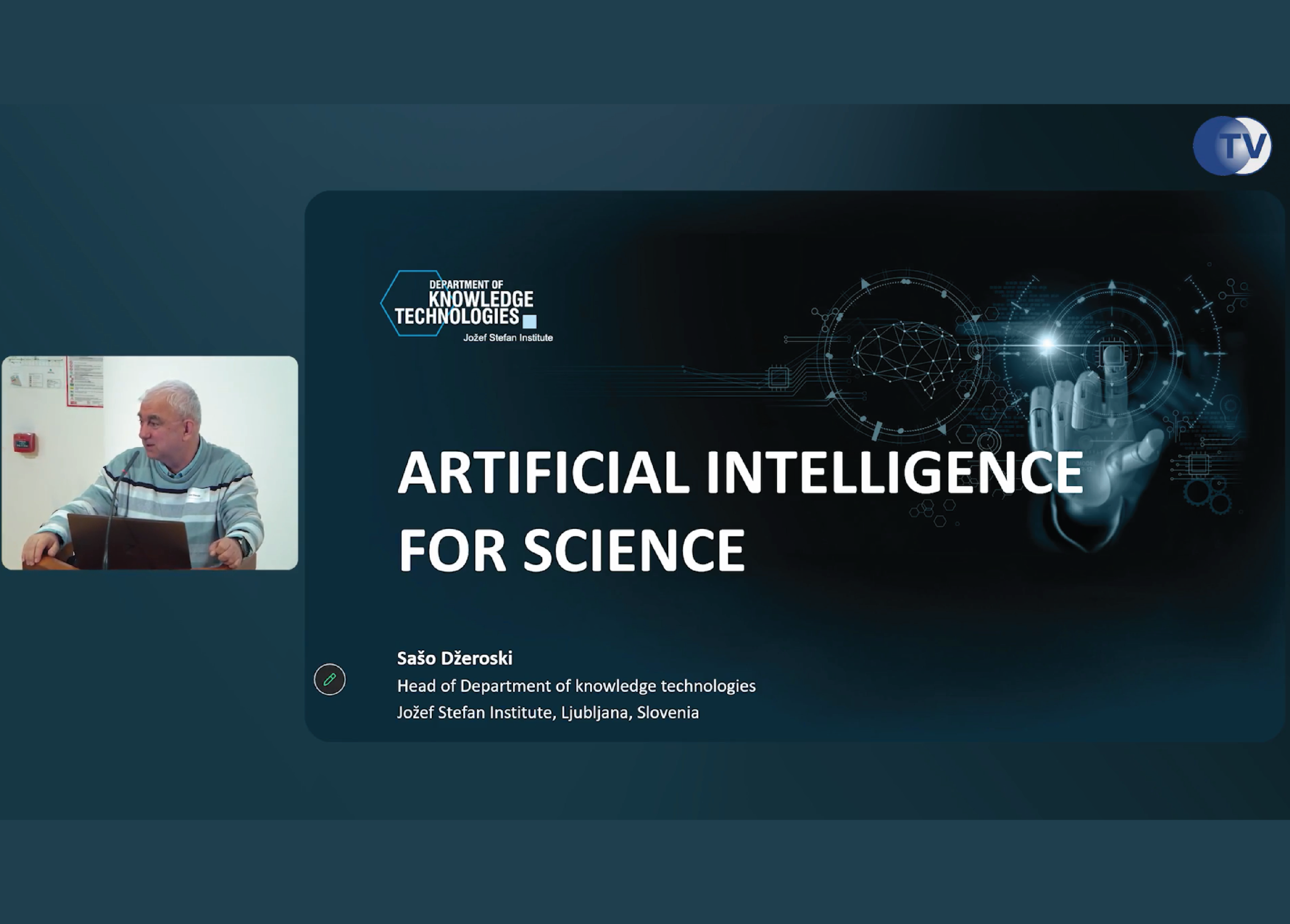
Sašo Džeroski had a talk on Artificial Intelligence and science.
Artificial intelligence is already transforming science across many disciplines, and its future impact is expected to be even greater. Realizing this potential, however, requires addressing challenges specific to scientific work: ensuring that models and their predictions are explainable, learning effectively from the limited labelled data that is typical in science, integrating data with existing domain knowledge, and supporting open and reproducible science through the formalization and sharing of scientific knowledge. This course introduces AI methods developed with precisely these challenges in mind.
The course covers a range of methods suitable for use in science, including explainable machine learning — with trees and ensembles for multi-target prediction as key examples — that produce accurate yet interpretable (or explainable) models for complex scientific domains. It also addresses learning from limited data through two complementary paradigms: semi-supervised learning, which makes use of unlabelled alongside labelled data, and foundation models, which bring representations learned from vast data to bear on data-scarce problems. Further topics include automated scientific modelling, in which interpretable models of dynamical systems are learned from time series data and domain knowledge, and semantic technologies and ontologies for representing and sharing scientific knowledge.
The course will also present many examples of applying these methods to problems from different branches of science. The methods will be illustrated with concrete applications in life sciences, environmental sciences, and materials science. The course will conclude with a presentation of the Slovenian AI Factory and the opportunities it offers to the scientific community.
Attendees will leave with a good overview of the current AI-for-science methodological landscape, a grounding in applications to a variety of sciences and a clear picture of how AI factories (and in particular SLAIF) can support their work in the area of AI for Science.
Video is already available….